
New Paragraph

Has society become desensitized to critical issues?: Lewis
June 24, 2023

Has society become desensitized to critical issues?Or have our priorities gone completely awry? Perhaps both?

For example, it is truly awful that five people lost their lives in the North Atlantic while riding in a private company’s unsafe submersible, having paid hundreds of thousands of dollars to tour the aquatic gravesite of the RMS Titanic. But it became international news fodder for days while taxpayers from several countries paid millions upon millions of dollars to try and rescue these folks who had knowingly put their own safety at risk.


Don’t get me wrong. Of course they had to search and try to save those lives. We always do and always will. We don’t abandon ill-prepared and -equipped hunters who get lost in the bush because of their economic class.


My point here is that we won’t spend money on critical issues, and we don’t give attention to the plight of those who aren’t living the lifestyles of the rich and famous. Would the entire international community respond en masse to a sinking boatload of Cuban immigrants? And would it top the media cycle for four straight days?


If we collectively put half the North American media and public focus and funding used during the Titan implosion on vulnerable people, crime prevention, homelessness and policing alone, we’d save many more lives than five.


What else was going on concurrently last week that received little leading news coverage, no public fury and a complete lack of tax dollar commitment to prevent a recurrence?

In North America alone, kids are being abused, going to school hungry, and being led down a path where drugs and crime will become their only option in life, each and every day. Unhoused people, and those affected by mental health issues and or addictions, are living on sidewalks or in encampments. Violent crime is increasing in both urban and rural areas. On average there is more than one mass shooting per day in the United States. Canada’s numbers are much less stark, but remain concerning.


Schools are attacked and kids killed or forever traumatized with regularity. Seventy-five people were shot in Chicago last weekend alone – 14 of them fatally. Hundreds of refugees drowned in the Mediterranean Sea last week as they fled their homelands for better lives. That tragedy received only an infinitesimal amount of media coverage in comparison to the deaths of the billionaire adventurers.


More cops have been murdered in Canada in the past year than in any other year in history. Almost daily a police officer is shot in the U.S. At the same time so many continue to call to “defund police” and therefore impact officer safety and put prevention and community safety programs at risk. Where is the broad public outcry and headline news? We hardly ever talk about those societal issues comparatively.


Then there’s never-ending, nauseating government waste; spending more public funds on issues in other countries than on our own social service agencies, homelessness and our veterans; the vilification of police – sometimes by elected officials, including pulling them from schools; getting soft on crime; scales of justice that almost always tips towards criminals – giving more rights to them than to their victims and to the police who are trying to prevent violence and victimization. I could go on.


In one 24-hour period last year I watched a police funeral for two fallen Edmonton Police heroes that were shot and killed. These fine young men represented the eighth and ninth murders of Canadian police officers in seven months. Just before their funeral service began, news from the U.S. emerged regarding another mass shooting at a school, with three children and three adults dead. The shooter there was quickly shot and killed by responding Nashville police. Shortly thereafter, a Sergeant in the Sûreté du Québeclost her life after being stabbed while arresting a suspect in Louisville, Que. She was the second female officer murdered in Canada since RCMP Constable Shaelyn Yang was killed in Burnaby B.C. in last October.


As CTV’s Public Safety Analyst, in years gone by, I would have received numerous calls for interviews from the network TV and radio stations regarding each of these horrific events. But I didn’t. I only received a few calls regarding the huge Edmonton funeral.


Please know I am not complaining about a lack of work. Not at all. But it is simply an indicator to me that things have changed dramatically in the nine years I’ve been on contract to Bell Media. The public is getting desensitized to real public safety and socio-economic issues and mainstream news reporting that is unbiased and verified.


Why? Have we as a society hardened ourselves to public acts of violence? Has there been so many mass shootings, suicides, fentanyl deaths, mental health crises and cops being killed for no other reason than their uniforms, that we don’t react with the same shock, awe and thirst to fix it? Do we now take those tragedies and horrendous issues impacting large segments of society for granted as being inevitable life events and the new norm?


God, I hope not, but once again, I’m not optimistic.

Chris Lewis served as Commissioner of the Ontario Provincial Police from 2010 until he retired in 2014. He can be seen regularly on CTV and CP24 giving his opinion as a public safety analyst.
By Chris Lewis June 6, 2026
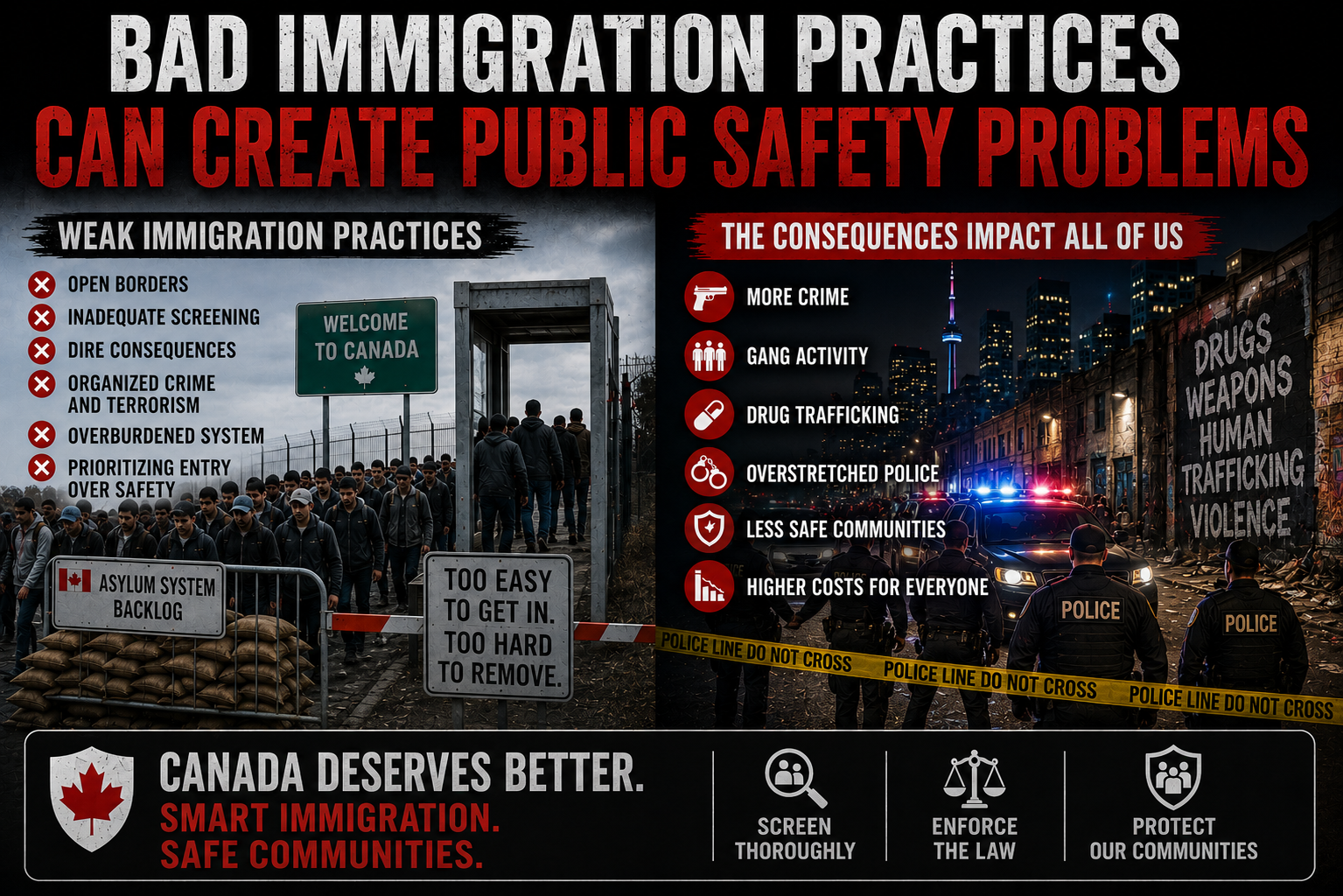
Police become the default response to bad immigration policy
By Chris Lewis March 28, 2026
Leadership is inundated with risk, every hour of every day, in all sectors. In policing, legislative authorities and established policy are the ever-present guideposts, but occasionally policy just doesn’t apply. At times someone has to just make a decision to do something, or not, or they will fail the public they serve and the personnel it is their duty to lead. If it goes bad, time to own up, do damage control, learn from it and move forward. It always frightened me when I saw some at the senior executive level in policing think that supervisors and managers operate in a pristine little bubble where nothing should ever go wrong. Then when it did because some supervisor tried their best to make something work for all the right reasons, they wanted to pigeon-hole the person that took the risk. There were times during my own career when executives were not encouraged to take any risk either. In fact, taking risk was career risk in itself. Despite the best of intentions, if it went bad, the one ‘responsible’ be forever labelled as having failed. Even if the gamble went well, the jaundiced eyes from above would still forever look at them as being a potential liability. It became the “Oh, him. He’s the one that...” At times the daily decision making of high-level commanders would be second-guessed by those in the executive suites – some of whom had never really commanded anything. My buddy retired Chief Wayne Frechette used to describe these folks as: “They’ve never been out after dark on company time.” I know this same concept was alive in many other police services. Some at executive levels actually did serve in operational roles at some point but they never took a risk. Somehow, they were fortunate to skate through difficult situations through sheer luck as opposed to good decision-making and never developed any scar tissue along the way. They didn’t learn from failure – they survived by luck. They also were viewed by weak executives above them as being golden because there was never a milli-second of negativity around them. They were Teflon. But those that worked under their “command” (for lack of a better word) had no respect for them. They simply watched them walk around with coffee in hand, never leaving the office or making a decision. It wasn’t leadership, but it did pave the way to stardom from on high, for some. True leaders do take risks at times. Many I worked with and for did it all and did it well. They did so in the best interests of those they served and those they led, because it wasn’t about themselves, but was done in the service of those that placed their trust in them. Policy simply doesn’t fit every situation. It is most often a guide that anticipates most circumstances that employees will face, particularly the more common (high-frequency) ones. But it cannot predict every possible scenario. When that happens in policing, it can occur in very unlikely situations (low-frequency) that are incredibly high-risk. Supervisors cannot say “Sorry folks, the book doesn’t cover this one” and run away crying. They also don’t have time to tell bad guys, “Hey big fella, sit tight. We need to take a pause here and get the whiteboard out so we can have a group-think about how to stop your murderous rampage.” I think that many pseudo-leaders – far too many, are afraid to make risky decisions out of fear that an error will jeopardize their career. Instead, they risk their careers by not making decisions. Or as I like to say: “their fear of career-risk, risks their careers.” This can be fatal in the policing world. When a police supervisor shirks their responsibilities or quivers, sucks their thumb, and prays for the situation to go away, thankfully constables will come forward and do their best to get their teammates through it. Sometimes that ends well and when the supervisor emerges from their fear-induced coma, they will more often than not take credit for the success. But when the situation goes to hell-in-a-handbasket – despite best efforts, the pseudo-leader will document the risk-taking employee and add another bullet-point to their list of things they’ve done to “hold people accountable.” The panel at their next promotional interview will likely hear the false rendition proudly told. I hear examples of this practise from serving police officers across North America on a much too frequent basis. True leaders develop a culture of trust among those they lead that their suggestions and feedback are encouraged and valued. Their confidence that the leader wants their input encourages them to constantly analyze situations and give thought to what policy says and the options available when policy says nothing. That is good for the employee’s development and may save the leader’s hind-end and the continuity of the team on occasion when an employee steps forward in a crisis. Having said that, there will clearly be situations where there isn’t time for the whiteboard, and a decision needs to be made by the responsible “leader.” When it doesn’t work out, the real leader will step forward and be accountable. But when it does go well, the true leader will allow the light to shine on the team they have the honour to lead. In my view, we’re not seeing enough of that in North American policing. We need more genuine leaders at all levels of law enforcement organizations. Developing and promoting real leaders that can manage risk effectively is a must. Anything less fails everyone.
By Chris Lewis March 26, 2026
They used to be simply a "nice to have."